What 'Reconditioned' Really Means: Reconditioned Audi Allroad Engine — And Why the Term Could Cost You Thousands
July 1, 2026
Stop Your Audi Allroad from Reaching the Scrapyard: The Reconditioned Engine Truth That Puts You Back in Control
Quick Answer Box
A reconditioned Audi Allroad Engine (typically the 4.2L V8 codes like BAS, APB, ARE, BEL, or BES) usually means a used unit that has had obvious failed parts replaced, been cleaned, and reassembled. It is not a full factory-standard overhaul. A rebuilt or remanufactured version goes further with machining and new internals for closer-to-new tolerances. Expect reconditioned engine costs in the UK of £2,500–£5,000+ fitted for these V8s, versus higher for proper remanufactured or a used donor. Always demand detailed build sheets, tolerances, and a meaningful warranty. Blindly buying on the vague label "reconditioned" risks another failure and thousands in repeated costs.
Power Opening
Your Audi Allroad has just been diagnosed with a terminal engine fault. The quote for a new unit is eye-watering, and the scrappage offer feels like robbery. You’re not a mechanic, yet suddenly you’re drowning in terms: reconditioned Audi Allroad engine, rebuilt Audi Allroad engine, replacement Audi Allroad engine, used, remanufactured. Dealers and brokers throw them around interchangeably, often hiding what you’re actually getting. This confusion is not accidental—it protects their margins while exposing your wallet. This guide strips away the jargon with clinical precision so you can make an informed decision and keep your Allroad on the road without financial ambush.
Before you search another listing, read this.
What Does Engine Failure Actually Mean for Your Reconditioned Audi Allroad Engine – and What Are Your Real Options?
Engine failure in the Audi Allroad 4.2L V8 often arrives suddenly: a rattle on cold start that escalates, loss of power, or a catastrophic bang from timing components. Mechanics typically confirm via compression testing, borescope inspection of cylinders and valves, and leak-down tests. For the C5 Allroad’s chain-driven 4.2 V8 (079-series engines like BAS), the verdict frequently points to the rear-mounted timing chain system.
Your options boil down to repair (often uneconomic on these V8s), a used engine, a reconditioned Audi Allroad engine, a rebuilt one, or full remanufactured. Choosing blind risks repeating the failure.
Many "engine gone" diagnoses on these cars stem from preventable timing chain issues that a thorough inspection could have flagged earlier—yet full disclosure might steer you toward a cheaper temporary fix instead of a proper replacement.
Cost Summary Box (Approximate UK Market, Fitted):
- Used donor: £1,500–£3,500 (high mileage risk)
- Reconditioned: £2,500–£5,000+
- Proper rebuilt/remanufactured: £4,000–£7,000+ with better warranty Labour for swap: £1,500–£3,000+ due to complexity.
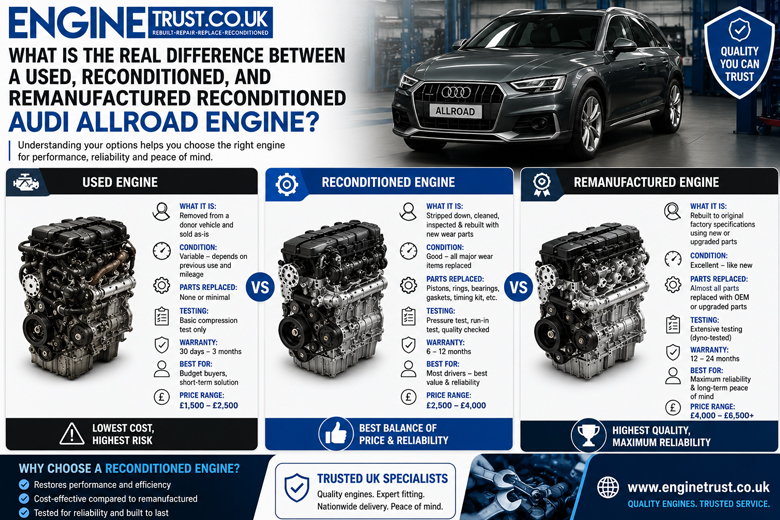
What Is the Real Difference Between a Used, Reconditioned, and Remanufactured Reconditioned Audi Allroad Engine?
The automotive industry deliberately blurs these terms because there is no strict legal UK definition for "reconditioned." This allows sellers to avoid accountability and prevents easy price/quality comparison.
Here’s the clinical breakdown:
| Engine Type | Definition | Typical Process | Warranty Depth | Risk Level | Best For |
|---|---|---|---|---|---|
| Used | As-removed from a donor vehicle | Minimal inspection, possibly run-tested | 1–3 months parts only | High (unknown history) | Budget short-term |
| Reconditioned / Rebuilt | Failed parts replaced, cleaned, reassembled | Replace obvious wear (e.g., bearings, gaskets); limited machining | 3–12 months | Medium (internals may still be fatigued) | Most common option |
| Remanufactured | Full disassembly, inspected/machined to OEM tolerances (e.g., crankshaft journals to ±0.0025mm), most components renewed or upgraded | Comprehensive restoration, often better than original | 12+ months unlimited mileage | Lowest | Long-term reliability |
What they don't tell you is that a "reconditioned" unit is often just a cleaned-up used engine with new rings or bearings—hardly a guarantee against the same failure modes.
The profit margin on vague "reconditioned" engines is higher because they require less workshop time than a true remanufactured unit, yet they can still be sold at a premium with minimal guarantees.
Entity Map: Audi Allroad C5 4.2 V8 → Engine Codes (APB, ARE, BEL, BES, BAS) → Primarily 079-series chain-driven → Compatible with certain B6/B7 S4 variants but verify ancillaries, wiring, and mounts.
What Are the Known Failure Points of the Reconditioned Audi Allroad Engine That Every Buyer Must Know Before Purchasing?
The 4.2L V8 in the Allroad (especially BAS and related codes) is notorious for rear timing chain guide failure. Plastic guides crack, chains stretch or jump teeth, leading to bent valves, scored pistons, or full catastrophic damage.
Other common issues include oil leaks, carbon buildup (on certain variants), and ancillary failures like coolant pumps or variable valve timing components. These engines sit low and work hard in the Allroad’s quattro system, accelerating wear.
Many donor engines pulled for "reconditioned" stock come from vehicles with the exact same unresolved timing issues—buying one without updated guides/tensioners is rolling the dice again.
Is a Replacement Audi Allroad Engine ULEZ Compliant and What Does UK Law Actually Protect You With?
A like-for-like replacement Audi Allroad engine of the same spec should maintain ULEZ compliance, as emissions are tied to the original vehicle type. However, significant modifications require DVLA notification and could affect MOT emissions testing. Always match or exceed the original Euro standard.
Under the Consumer Rights Act 2015, goods (including a reconditioned engine) must be of satisfactory quality, fit for purpose, and as described. You have rights to repair, replacement, or refund if it fails early—stronger against traders than private sellers. Demand clear documentation for the V5C update.
Vague descriptions like "reconditioned" make it harder to prove breach of "as described," weakening your legal position if things go wrong.
What Should You Know About Timing Chain and Tolerance Specs When Buying a Reconditioned Audi Allroad Engine?
For these 4.2 V8s, proper reconditioning demands precise measurement of crankshaft journals, cylinder bores, and installation of upgraded timing components (metal-backed guides where possible). Factory tolerances are tight; anything outside risks rapid wear.
Many budget "reconditioned" units skip full disassembly and critical measurements, leading to premature failure despite the label.
What Are the ULEZ, VED, and MOT Implications of Fitting a Replacement Engine in Your Audi Allroad?
Fitting a matching replacement engine usually preserves VED band and ULEZ status. Non-matching capacity or emissions can trigger re-registration, potential fines, or MOT failure. Post-swap, expect a fresh emissions test; a well-built engine improves pass probability.
Some cheaper engines come from higher-mileage or differently specced donors, quietly affecting your tax and compliance without disclosure.
Explore More Audi Allroad Engine
- 1 Timing Chain Nightmare? Why My Reconditioned Audi ALLROAD 2.0 TDI Engine Lasted 87,000 Miles Without Failure
- 2 Supply and Fitting” For Audi Q3 Engine – The Hidden Liability Handshake They Want You to Sign
- 3 Why a Used Audi SQ5 Engine Failed My Customer in 3 Months (And a Recon Never Would)
- 4 Rebuilt vs Used Audi Q7 Engine: Hands-On Comparison Based on Real Failures, Costs & Long-Term Reliability
- 5 The Shocking Truth: My Real-World Experience with A Used Audi Q3 Engine Swap
People Also Ask
What is the difference between reconditioned and rebuilt Audi Allroad engine?
Reconditioned typically means selective replacement of failed parts with minimal machining, while rebuilt implies more comprehensive work. Neither has a fixed legal definition in the UK, so always request a detailed build sheet. True remanufactured engines restore to tighter tolerances.
How much does a reconditioned Audi Allroad engine cost?
Expect £2,500–£5,000+ fitted in the UK, depending on specification and warranty. Labour is significant due to the V8 layout.
Is a reconditioned engine as good as new for the Audi 4.2 V8?
No. A quality remanufactured unit comes closest, with new or machined components to OEM specs. Standard reconditioned carries higher risk of latent wear.
What are the most common failure points in the Audi Allroad 4.2 BAS engine?
Rear timing chain guides and tensioners that crack or fail, leading to chain stretch and potential valve/piston damage.
Does fitting a replacement engine affect ULEZ compliance on an Audi Allroad?
A direct like-for-like swap should not, provided it meets the original emissions standard. Notify DVLA of changes and verify for MOT.
How long does a reconditioned Audi 4.2 engine last?
With proper work and maintenance, 80,000–150,000+ miles are possible. Poorly done units may fail within 20,000–30,000 miles.
What tolerances should a professional reconditioned Audi V8 engine meet?
Crankshaft journals and bores should be measured and machined to within factory specs (often ±0.0025mm or better). Ask for documentation.
Can I legally use a different engine code in my Allroad?
Yes, with compatibility checks and DVLA notification if specs change significantly. Insurance and warranty implications apply.
Your Audi Allroad deserves better than another gamble on vague terminology. Arm yourself with these definitions, demand transparency on build quality and history, and choose a supplier who provides proper documentation and a robust warranty. The right reconditioned Audi Allroad engine—or better, a properly remanufactured one—can give your car a reliable second life. Take control before the next breakdown decides for you. Contact a specialist with verifiable expertise in these V8s today.
Written by John Miller | Dedicated ET Automotive Writer & Mechanic.
Categories
- Uncategorized
- Audi Engines
- BMW Engines
- MINI Engines
- Volkswagen Engines
- Replacement Car Engines in UAE
- Infotainment System
- SUV
- Mercedes Benz Engines
- Citroen Engines
- Engine Care
- petrol engine
- petrol engines
- Citroen C3 Engines
- Ford Engines
- Land Rover Engines
- Jaguar Engines
- Range Rover Engines
- Nissan Engines
- Mazda Engines
- Iveco Engines
- Hyundai Engines
- Range Rover Sport Engines
- Vauxhall Engines
- KIA Engines
- Mercedes Engines
- Toyota Engines
- Hyundai i20 Engines
- Renault Engines
- Infographic
- SEAT Engines
- BMW 5 Series Engines
- Skoda Engines
- Euro NCAP
- Skoda Fabia Engines
- Suzuki Engines
- Fiat Engines
- Mitsubishi Engines
- Volvo Engines