Stop! Before Buying a Second-Hand Ford Transit Engine, Read This Urgent Expert Warning
May 4, 2026
Expert Warning: The Hidden Dangers of Buying a Second-Hand Ford Transit in the UK
Buying a second-hand Ford Transit engine can appear to be a quick and cheap fix for your van. However, thousands of UK drivers every year end up with expensive regrets after discovering hidden damage, poor compression, or worn timing systems. From snapped timing belts on older 2.2 Duratorq units to disintegrating wet belts on the latest 2.0 EcoBlue, one overlooked fault can turn a £1,500 “bargain” into a complete write-off.
The key takeaway? Always verify full-service history, mileage, and get a professional compression and leak-down test before purchase. Engine replacement costs typically range from £2,800–£5,500 including supply and fit. Engine Trust is a price comparison platform, not a direct engine seller. Final pricing, warranty terms, and availability vary by vetted UK supplier. Professional diagnosis is recommended before purchasing any replacement engine.
Why You Must Think Twice Before Buying a Second-Hand Ford Transit Engine
A second-hand Ford Transit engine is a previously used diesel power unit removed from a donor van. It is often sold as a “running take-out” or “low-mileage pull” and offered online or through breakers yards across the UK.
Think of it like buying a second-hand heart for your van — it might still beat strongly, but without proper checks it could fail catastrophically and leave you stranded on the hard shoulder of the M6 or A1.
Technically, a second-hand Ford Transit engine is any complete 2.2 Duratorq, 2.4 Duratorq, or 2.0 EcoBlue diesel engine that has already powered one or more vehicles. Most UK examples come from high-mileage ex-fleet vans that have endured years of stop-start city work, motorway hauls, and heavy payloads.
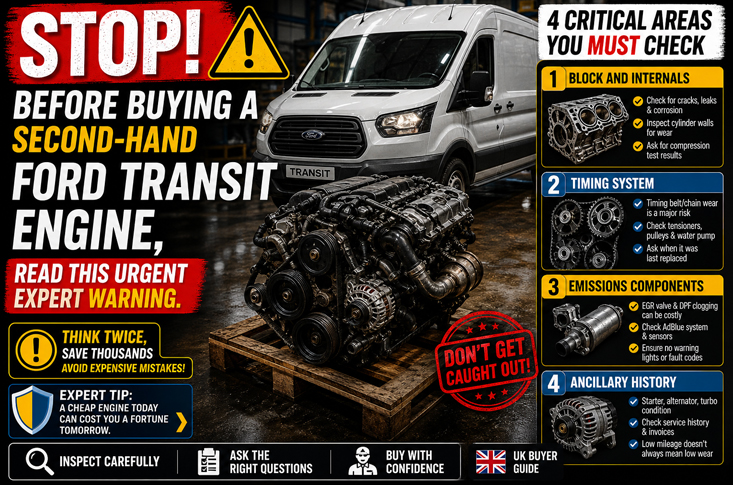
The Technical Breakdown
Here’s what you’re actually buying in four simple steps:
- Block and internals — The core cast-iron or aluminium block with pistons, crankshaft and bearings that have already covered tens or hundreds of thousands of miles.
- Timing system — Dry belt on older 2.2 Duratorq or wet belt on 2.0 EcoBlue — the single biggest failure point.
- Emissions components — DPF, EGR valve, turbo and injectors that may be partially clogged or worn.
- Ancillary history — Unknown oil change intervals and potential water or oil contamination from previous use.
Key Components of a Second-Hand Ford Transit Engine
The Core Engine Block
This is the foundation of every second-hand Ford Transit engine. Older Mk7 models use the robust 2.2 and 2.4 Duratorq engines, while newer Mk8 vans run the more efficient 2.0 EcoBlue. For UK owners it matters because these engines are interference designs — a failed timing belt usually destroys valves and pistons.
Timing System (Belt or Wet Belt)
The timing belt drives the camshaft and injection pump. On 2.0 EcoBlue models the wet belt sits in oil and degrades faster than expected. Failure often occurs between 80,000–120,000 miles and leads to total engine destruction.
Fuel and Emissions Systems
Includes high-pressure injectors, turbocharger, EGR valve and DPF. These components suffer heavily from short urban journeys typical in London, Manchester and Birmingham, leading to frequent regeneration issues and power loss.
Ancillaries and Sensors
Turbo actuator, oil pump, water pump and wiring loom all come with the engine. Many second-hand units are sold without these, forcing buyers to transfer old parts that may already be tired.
Different Types and Variants of Second-Hand Ford Transit Engines
| Type | Key Feature | Best For | UK Availability |
|---|---|---|---|
| 2.2/2.4 Duratorq (2006-2013) | Dry timing belt, strong low-end torque | Budget repairs, long motorway runs | Very high – most common in breakers |
| 2.2 Duratorq (2014-2016) | Improved emissions, transitional Euro 5/6 | Mixed city and motorway use | Good supply |
| 2.0 EcoBlue (2016+) | Euro 6 ULEZ compliant, better fuel economy | Clean Air Zone compliance | Most plentiful on current market |
| Transit Custom engines | Same engine codes, slightly different tuning | Smaller vans and lighter payloads | Widely available |
Top Advantages of Buying a Second-Hand Ford Transit Engine
Lower Upfront Cost
A second-hand Ford Transit engine can cost £800–£2,200 compared to £3,500+ for a fully reconditioned engine, helping UK van owners keep their business running without massive outlay.
Faster Availability
Many breakers and online sellers can deliver a second-hand unit within 24–48 hours anywhere in the UK — ideal when your van is off the road and every day costs money.
Original Factory Specification
You get the exact engine code and mapping that matches your Ford Transit, avoiding potential ECU compatibility issues that sometimes arise with reconditioned or imported units.
Good for Temporary or Low-Mileage Fixes
If your van only needs to last another 50,000–80,000 miles, a carefully chosen low-mileage second-hand Ford Transit engine can provide reliable service at minimal cost.
Real Disadvantages and Limitations of Second-Hand Ford Transit Engines
Unknown Service History and Mileage
Most second-hand engines lack full documented history. True mileage is often unknown or clocked, leading to premature failure of timing systems, turbo or DPF.
High Risk of Catastrophic Failure
A snapped timing belt on a 2.2 Duratorq or degraded wet belt on a 2.0 EcoBlue can destroy the entire engine within seconds. Repair bills then exceed the cost of a reconditioned engine.
Worn Emissions Components
DPF, EGR and injectors from urban vans are often partially blocked. Fitting one into your van can trigger immediate fault codes, limp mode and expensive diagnostics.
No or Very Short Warranty
Most second-hand Ford Transit engines are sold as “spares or repairs” with little to no warranty, leaving UK buyers fully exposed to early failure.
Important UK-Specific Considerations for Buying a Second-Hand Ford Transit Engine
ULEZ compliance is critical. Only engines from Euro 6 donor vehicles (mainly 2.0 EcoBlue registered after September 2015) will keep your van legal in London, Birmingham, Bristol and other Clean Air Zones.
UK road conditions and climate accelerate wear. Salt on winter roads and frequent short trips common across British cities quickly degrade DPF and EGR systems in second-hand units.
Servicing at independent UK garages is far cheaper (£180–£280 for a full service) than main dealers, but many specialists refuse to fit untested second-hand engines due to the high risk of comebacks.
Always check the donor vehicle’s V5C and MOT history where possible before committing.
Maintenance, Longevity and Common Failure Points
A carefully selected second-hand Ford Transit engine may last 80,000–150,000 miles if it came from a well-maintained donor. However, average real-world lifespan is often much shorter due to prior abuse.
Expected lifespan: 100,000–140,000 miles maximum before major issues appear.
Common failure points:
- Timing belt or wet belt failure (catastrophic on interference engines)
- DPF clogging and regeneration issues
- Injector wear and fuel rail problems
- Turbo failure due to oil starvation
Maintenance intervals (after fitting): Oil and filter every 10,000 miles or 12 months. Inspect or replace timing components immediately upon installation.
Warning signs UK owners should know: Rattling on cold start, blue or black smoke, sudden power loss, engine management light, or low oil pressure.
Ford Transit Engine Replacement Options in the UK
When a second-hand Ford Transit engine fails or proves too risky, you have better long-term choices:
Used engines (£800–£2,200) — cheapest but highest risk. Reconditioned engines (£2,800–£4,500) — fully stripped, rebuilt with new pistons, bearings, timing kit and often a 12-month warranty. Supply-and-fit packages from vetted UK suppliers usually cost £3,500–£6,500 all-in, providing peace of mind and faster return to work.
Engine Trust makes it simple to compare reconditioned and used Ford Transit engines from trusted suppliers nationwide.
FAQ – Second-Hand Ford Transit Engine Questions Answered
What are the most common problems with a second-hand Ford Transit engine?
Timing belt or wet belt failure, DPF clogging, EGR valve issues and injector wear top the list. Older 2.2 Duratorq engines often suffer catastrophic belt snap, while 2.0 EcoBlue wet belts degrade and contaminate the oil system.
Are second-hand Ford Transit engines ULEZ compliant?
Only units from Euro 6 donor vans (mainly 2.0 EcoBlue registered from September 2015 onwards) are fully ULEZ compliant. Always confirm the donor registration date on the V5C.
How long does a second-hand Ford Transit engine typically last?
Realistically 80,000–150,000 miles if lucky. Many fail much sooner due to unknown prior mileage and poor servicing history. Proper timing system replacement at fitting greatly improves chances.
How much does fitting a second-hand Ford Transit engine cost in the UK?
The engine itself ranges from £800–£2,200. Add labour, new timing kit, gaskets and potential DPF/injector repairs. Total supply-and-fit often reaches £2,500–£4,500 — sometimes more than a reconditioned engine.
What should I check before buying a second-hand Ford Transit engine?
Demand compression and leak-down test results, oil pressure readings, service history from the donor van, and proof of timing belt condition. Always use a trusted independent Ford specialist for inspection.
Conclusion: Make the Smart Choice with Your Ford Transit Engine
Buying a second-hand Ford Transit engine can save money in the short term, but the risks of hidden damage, early failure and lost work time are very real for UK van owners. Prioritise proper testing, consider ULEZ requirements, and weigh the long-term benefits of a reconditioned engine instead.
Ready to find a reliable replacement engine for your Ford Transit? Visit Engine Trust today, compare live quotes for both used and reconditioned Ford Transit engines from vetted UK suppliers, and get back on the road with confidence and transparent pricing.
Written by John Miller | Dedicated ET Automotive Writer & Mechanic.
Categories
- Uncategorized
- Audi Engines
- BMW Engines
- MINI Engines
- Volkswagen Engines
- Replacement Car Engines in UAE
- Infotainment System
- SUV
- Mercedes Benz Engines
- Citroen Engines
- Engine Care
- petrol engine
- petrol engines
- Citroen C3 Engines
- Ford Engines
- Land Rover Engines
- Jaguar Engines
- Range Rover Engines
- Nissan Engines
- Mazda Engines
- Iveco Engines
- Hyundai Engines
- Range Rover Sport Engines
- Vauxhall Engines
- KIA Engines
- Mercedes Engines
- Toyota Engines
- Hyundai i20 Engines
- Renault Engines
- Infographic
- SEAT Engines
- BMW 5 Series Engines
- Skoda Engines
- Euro NCAP
- Skoda Fabia Engines
- Suzuki Engines
- Fiat Engines
- Mitsubishi Engines
- Volvo Engines