Peugeot 1.6 HDi Engine Replacement Cost UK | Engine Trust
November 2, 2026
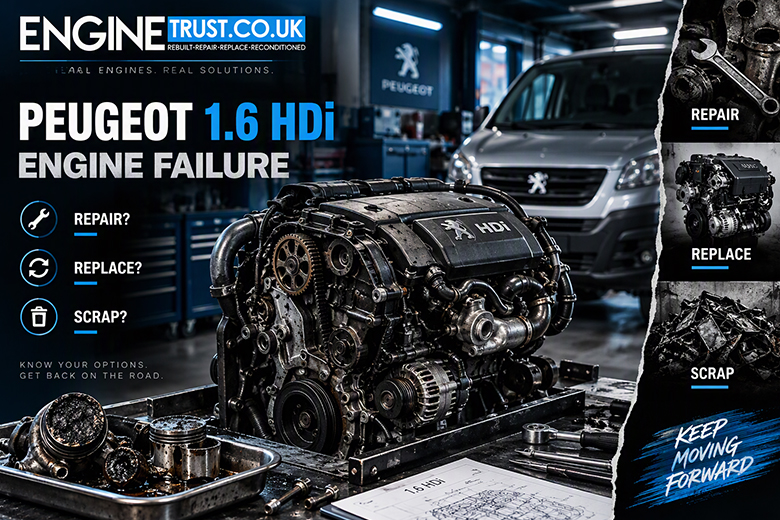
Peugeot 1.6 HDi Engine Replacement Cost UK: Repair, Replace or Scrap?
By Engine Trust | Independent Diagnostic Technician | Reviewed by John Miller | Updated 02 November 2026
Quick answer: A Peugeot 1.6 HDi engine replacement cost in the UK depends on the exact DV6 variant, engine condition and complete fitted scope. Repair can make sense when damage is localised and the rest of the car is sound. Compare a used or reconditioned engine when internal damage is confirmed; consider selling as spares or repair when the total bill and remaining faults make the work uneconomical. Obtain a written diagnosis before committing.
This guide is for UK Peugeot owners comparing engine repair, replacement and scrap options. Engine Trust lets you compare Peugeot engine quotes from suppliers offering used and reconditioned units, with supply and fitting options. Confirm current availability, exact engine compatibility and written warranty terms with the supplier before ordering.
How much does a Peugeot 1.6 HDi engine replacement cost in the UK?
There is no single dependable fitted price without the vehicle registration, full engine code and a diagnosis. A supply-only engine price is not the total replacement cost. Ask for separate costs for the unit, labour, recovery, delivery, VAT, fluids, timing components, coding and any ancillary repairs.
Used or reconditioned? Compare both on the same supplied-and-fitted basis. A used engine needs donor-history and test evidence; a reconditioned engine needs a written rebuild specification. Neither description alone establishes value, compatibility or warranty cover.
Before requesting a quote: Have your registration, VIN, engine code, symptoms, diagnostic report, postcode and preferred supply-only or fitting service ready. Use comparable written quotes rather than an advertised engine price to judge whether repair or replacement is worthwhile.
What should you do first?
Stop driving if there is low oil pressure, heavy knocking, overheating, runaway revs or dense smoke. Recover the car and ask for a written diagnosis. A turbo fault, leaking injector seal, failed ancillary or blocked oil supply can resemble complete engine failure, yet require a different repair.
Ask the workshop to record the fault codes and the tests used. Depending on the symptoms, useful evidence may include compression or cylinder-leakage results, injector leak-off results, oil-pressure checks, turbo inspection and examination of the oil and filter for metal debris.
Why does the DV6 engine fail?
The PSA DV6 family appears in many Peugeot and Citroën models and in vehicles from other manufacturers. Failures often involve lubrication, combustion sealing or emissions-control problems rather than one universal defect.
- Injector seal leakage: combustion gases and carbon can build around an injector and damage the seat if left untreated.
- Turbocharger and oil-supply problems: contaminated oil, restricted oil flow or unresolved debris can damage a replacement turbo.
- DPF and EGR faults: repeated short journeys and unresolved regeneration problems can increase soot loading and oil contamination.
- Timing or internal wear: the remedy depends on the exact engine variant, damage and service history.
Peugeot 1.6 HDi repair, used engine or reconditioned engine?
| Option | Best suited to | Main checks | Key risk |
| Targeted repair | Localised turbo, injector-seal, cylinder-head or ancillary fault with a serviceable bottom end | Written diagnosis, damage limits and itemised parts | Treating a symptom while contamination or oil-flow problems remain |
| Used engine | Lower-value vehicle or short ownership horizon | Exact code, provenance, mileage evidence, compression test and written warranty | Unknown wear and limited cover |
| Reconditioned or rebuilt engine | Sound vehicle intended to be kept | Written build specification, measurements, replaced parts, testing and labour cover | Vague terminology that does not explain the work completed |
| Sell as spares or repair | Poor body, serious corrosion, multiple major faults or uneconomic total quote | Realistic offers, collection terms and legal paperwork | Accepting the first distressed-sale offer |
How do you decide whether the work is economical?
Use a simple comparison rather than a fixed rule:
- Estimate the vehicle’s realistic private-sale value in working order from comparable cars with the same age, mileage, condition and MOT history.
- Obtain at least two itemised quotes for the viable repair routes.
- Add likely ancillary work, recovery, transport and a sensible contingency.
- Subtract the full repair cost from the working value.
- Compare the result with genuine spares-or-repair and scrap offers.
- Consider how long you plan to keep the car and the risk covered by the written warranty.
A repair can make sense when the rest of the vehicle is sound, the diagnosis is specific and the completed car will be worth materially more than the total outlay. Selling may be more rational when the bill approaches the car’s working value, the shell has structural corrosion or several major systems also need attention.
How do you match a Peugeot 1.6 HDi replacement engine?
Do not buy on “1.6 HDi” alone. Confirm the full engine code, VIN, model year, power output, emissions equipment, gearbox compatibility and any required software or ancillary differences. DV6 variants are not automatically interchangeable.
Ask the supplier and installer to confirm compatibility in writing before dispatch. Clarify whether the offer is for a bare engine, a complete engine or a supplied-and-fitted package, because reused turbochargers, injectors, pumps and emissions components can change both price and risk.
What should a supplied-and-fitted Peugeot engine quote include?
- Engine condition and exact code.
- Supply-only or supplied-and-fitted scope.
- Labour, recovery, delivery and VAT.
- New fluids, filters, seals and timing components.
- Inspection or replacement of the turbo oil feed and return path.
- Injector, DPF, EGR and intercooler checks where relevant.
- Coding, adaptations and road testing.
- Warranty duration, mileage limit, exclusions, claim process and whether labour is covered.
How do you assess a used or rebuilt unit?
For a used engine, request donor details, mileage evidence, compression results and a clear warranty. For a rebuilt or reconditioned unit, request a build sheet naming the components replaced, machining performed, tolerances checked and tests completed. A label is not a specification.
Will an engine change affect the MOT, DVLA record or insurance?
An engine swap does not create a special MOT exemption. The vehicle must still satisfy the applicable inspection requirements, including emissions-control equipment, smoke or emissions limits, warning lamps and fluid leaks. Keep the replacement equivalent to the approved specification unless a competent specialist confirms otherwise.
Tell your insurer about the planned engine change before returning the vehicle to the road, and keep written confirmation. GOV.UK states that you must update your V5C when the engine or cylinder capacity changes. Follow the current DVLA guidance on changing vehicle details and keep the replacement invoice and supporting evidence.
What should you check after installation?
- Follow the installer’s running-in and service instructions.
- Check oil and coolant frequently during the early mileage.
- Investigate warning lamps, leaks, smoke, rattles or whistles immediately.
- Keep every invoice, test result and warranty document.
- Do not miss any early oil-and-filter change required by the installer.
How can you compare Peugeot engine quotes with Engine Trust?
Use Engine Trust to compare Peugeot engine options from suppliers rather than treating a headline engine price as a complete repair quote. Enter your vehicle registration, then ask the supplier and installer to confirm the full DV6 code and compatibility in writing. Compare the engine condition, test evidence, delivery or fitting arrangements, exclusions and warranty—not price alone.
Ready to compare? Get free Peugeot engine quotes through Engine Trust, then confirm whether each offer is supply-only or supplied and fitted. Ask for the full payable total and written warranty terms before accepting an offer.
Peugeot 1.6 HDi engine replacement FAQs
How much does a Peugeot 1.6 HDi engine replacement cost?
The fitted cost depends on the full DV6 code, engine condition and work included. Compare itemised UK quotes covering the engine, fitting, VAT, recovery, fluids, ancillaries, coding and warranty; a supply-only price is not a fitted total.
Is a used DV6 engine safe to buy?
It can be a practical budget option if the code is an exact match and the supplier provides provenance, mileage evidence, test results and written warranty terms. Unknown history remains the principal risk.
Is a reconditioned engine better than a used engine?
Potentially, but the label alone proves little. Judge the unit by its build specification, measurements, parts replaced, testing and warranty coverage.
Can a turbo fault be mistaken for engine failure?
Yes. Loss of power, smoke, oil consumption and noise can come from turbocharger or lubrication faults. A written diagnosis should establish whether the base engine is damaged.
Can different DV6 codes be swapped?
Do not assume so. Confirm the complete code, VIN, output, emissions equipment, gearbox, ancillaries and software requirements before purchase.
Should I repair the car or sell it as spares or repair?
Compare the full repair cost and residual risk with the car’s realistic working value and genuine offers in its failed condition. Body condition, corrosion, other faults and planned ownership period all matter.
Does a replacement engine affect the MOT?
The vehicle must still meet the applicable MOT requirements. Emissions equipment, warning lamps, smoke or emissions and fluid leaks remain relevant after an engine change.
Written by John Miller | Dedicated ET Automotive Writer & Mechanic.
Categories
- Uncategorized
- Audi Engines
- BMW Engines
- MINI Engines
- Volkswagen Engines
- Replacement Car Engines in UAE
- Infotainment System
- SUV
- Mercedes Benz Engines
- Citroen Engines
- Engine Care
- petrol engine
- petrol engines
- Citroen C3 Engines
- Ford Engines
- Land Rover Engines
- Jaguar Engines
- Range Rover Engines
- Nissan Engines
- Mazda Engines
- Iveco Engines
- Hyundai Engines
- Range Rover Sport Engines
- Vauxhall Engines
- KIA Engines
- Mercedes Engines
- Toyota Engines
- Hyundai i20 Engines
- Renault Engines
- Infographic
- SEAT Engines
- BMW 5 Series Engines
- Skoda Engines
- Euro NCAP
- Skoda Fabia Engines
- Suzuki Engines
- Fiat Engines
- Mitsubishi Engines
- Volvo Engines
- Peugeot