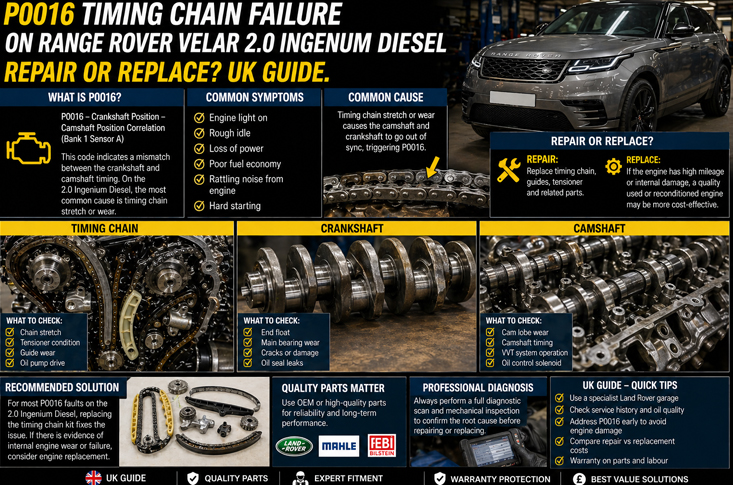
P0016 Timing Chain Failure on Range Rover Velar 2.0 Ingenium Diesel – Repair or Replace? UK Guide
April 27, 2026
Range Rover Velar 2.0 Ingenium Diesel Timing Chain Failure: Symptoms, Costs & When You Need a Replacement Engine in the UK
You're accelerating away from the lights in your Range Rover Velar engine when a sharp metallic rattle bursts from the engine bay on that cold start. The dashboard flashes "Restricted Performance" and the engine management light come on. That noise — the 2.0 Ingenium diesel timing chain stretching and slapping — is the exact sound thousands of UK Velar owners hear right before the timing chain jumps or snaps, bending valves and destroying the engine. You've been here before with the DPF light or a slightly smoky exhaust, but this time it's serious. Ignoring it now could leave you stranded on the M6 or A1 with a repair bill bigger than the car's value.
EXECUTIVE SUMMARY
Your Range Rover Velar 2.0 Ingenium diesel (engine codes 204DTD / 204DTA / AJ200D) has developed timing chain stretch or timing chain failure — the single most common catastrophic powertrain issue on 2017–2022 Velars in the UK.
Most likely causes: Oil dilution from incomplete DPF regenerations + extended service intervals thinning the oil and accelerating timing chain and plastic guide wear.
Urgency level: DO NOT DRIVE if you hear a persistent timing chain rattle on cold start or have active fault codes. Limp home only if the rattle is very brief and no warning lights are on — otherwise tow it. Continued driving risks the timing chain jumping teeth, valves hitting pistons, and total engine destruction.
Typical UK repair cost range:
- Timing chain kit + labour: £2,000–£3,500 (independent)
- Full engine replacement (if valves/pistons damaged): £5,000–£8,500 supply & fit (reconditioned unit)
Engine Trust is a UK price-comparison platform. We connect you with verified suppliers of reconditioned and used Range Rover Velar engines nationwide — we don’t sell engines ourselves but help you compare quotes instantly.
WHAT CAUSES Timing Chain Failure in Range Rover Velar 2.0 Ingenium Diesel — ROOT CAUSE ANALYSIS
1. Oil Dilution from DPF Regeneration Cycles
The 2.0 Ingenium diesel runs frequent passive and active DPF regens. When these are interrupted (short urban trips common for Velar owners), unburnt diesel washes past the piston rings into the sump. The oil thins dramatically and loses its ability to lubricate the timing chain and tensioners.
Component that fails: Timing chain itself (stretched) and plastic guides (wear and shed debris that blocks the oil pickup). Mileage range: As early as 40,000–60,000 miles in high-short-journey use. Risk if ignored: High — guides disintegrate, starve the timing chain of oil, chain stretches further, jumps teeth → bent valves and possible crankshaft damage.
2. Extended Service Intervals & Incorrect Oil Specification
JLR’s official interval is up to 15,000–20,000 miles or 2 years. In practice this is too long for the wet-belt/timing chain environment. Using non-STJLR.03.5007 spec oil (or the wrong viscosity) accelerates wear.
Component that fails: Chain tensioner and timing chain. Mileage range: 60,000–90,000 miles. Risk if ignored: Very high — tensioner collapses, chain slaps and eventually snaps.
3. Manufacturing Tolerances & Early Tensioner/Guide Design (Pre-2019 Engines)
Early Ingenium 2.0D units had known softer plastic guides and tensioner design. JLR issued updated parts in later production but many 2017–2019 Velars are still on original components. (No full UK recall, but TSB-style guidance exists in Topix for related timing chain rattle concerns.)
Component that fails: Upper and lower timing chains, guides, and hydraulic tensioner. Mileage range: 44,000–80,000 miles (forum reports confirm failures at 44k). Risk if ignored: Catastrophic — full engine failure in under 5,000 miles from first timing chain rattle.
HOW TO DIAGNOSE Timing Chain Failure in Your Range Rover Velar
Visual Inspection Checklist (No Tools Needed)
- Cold-start timing chain rattle that disappears after 10–20 seconds (classic early sign).
- Check engine oil level and condition — if it smells of diesel or looks thin and black after only 5,000 miles, oil dilution is present.
- Look for oil leaks around the rear of the engine (timing chain area).
- Monitor for “Restricted Performance” message or hesitation under load.
OBD-II Fault Codes
Common DTCs that scream timing chain issues:
- P0016 – Crankshaft/Camshaft Correlation Bank 1 (timing chain stretch)
- P0341 – Camshaft Position Sensor “A” Circuit Range/Performance
- P0011 / P0014 – Camshaft Timing Over-Advanced (tensioner or VVT issue)
- P0366 – Camshaft Position Sensor correlation (secondary code)
Pull codes with any decent OBD scanner or via the JLR SDD/Topix system.
Workshop Diagnosis
A specialist will:
- Run a JLR-specific timing chain stretch test (measures deviation in degrees).
- Perform a compression test and leak-down test.
- Remove the upper timing cover for visual inspection of guides and timing chain slack. Expect 1–2 hours diagnosis (£150–£250).
Questions to Ask Your Mechanic
- “What is the exact chain stretch reading in degrees?”
- “Have the plastic guides started shedding debris into the oil pickup?”
- “Is the damage limited to the timing chain or have valves/pistons been hit?”
- “Can you supply OEM or upgraded timing chain kit with revised tensioners?”
SEVERITY ASSESSMENT
| Symptom | Cause | Severity (1-5) | Action Required | Time Sensitive? |
|---|---|---|---|---|
| Brief cold-start rattle only | Early timing chain stretch | 3 | Book diagnostic within 1 week | Yes |
| Persistent rattle + restricted performance | Advanced stretch + guide wear | 4 | Stop driving — tow to garage | Immediate |
| Rattle + misfires + P0016/P0341 codes | Timing chain jumped teeth | 5 | Engine likely destroyed | Immediate |
| Noisy but still drives | Tensioner collapse | 4 | Do not drive further | Yes |
If severity reaches 4–5, the car is unsafe to drive and continued use will turn a £3k timing chain job into a £7k+ engine replacement.
REPAIR OPTIONS & UK COSTS
DIY
Feasibility: Not realistic. The timing chains sit at the rear of the engine; gearbox removal is often required on Velar. Specialist tools and timing pinning fixtures are mandatory. Skip DIY.
Independent Garage
UK average labour rate: £95–£120 + VAT per hour. Total for full timing chain kit (chains, guides, tensioners, gaskets): £2,000–£3,500 including labour (8–12 hours). Time required: 1–2 days.
Main Dealer
£150–£200 + VAT per hour. Quotes regularly £2,750–£7,700 depending on extent of damage. Pros: Warranty work if still covered. Cons: Significantly more expensive.
Engine Replacement — When Repair Cost Exceeds Engine Value
If the timing chain has jumped and valves are bent (common once codes are active), a full reconditioned engine becomes the smarter financial choice. This is where Engine Trust comes in — we compare live prices from UK reconditioners so you don’t overpay.
STEP-BY-STEP PROFESSIONAL FIX GUIDE (Chain Replacement)
This is a specialist job — here’s exactly what a good independent garage will do:
- Confirm fault with JLR diagnostic timing chain stretch test.
- Drain oil and remove gearbox (on many Velars) or work from the rear.
- Remove upper and lower timing covers.
- Pin crankshaft and camshafts in exact timing position.
- Replace both timing chains, all guides, both tensioners, and VVT units if required.
- Fit new oil pump pick-up strainer (critical to stop debris recirculation).
- Refit everything, torque to spec (chain tensioner bolts typically 10–12 Nm + angle).
- Refill with 6.5–7 litres of genuine STJLR.03.5007 0W-30 oil.
- Run final stretch test and road test.
Safety note: Always disconnect battery and support the engine properly.
PREVENTION: HOW TO AVOID THIS PROBLEM IN FUTURE
- Change oil every 10,000 miles or 12 months (whichever first) — ignore the 20k-mile JLR interval.
- Use only STJLR.03.5007 approved 0W-30 (Castrol EDGE Professional 0W-30 is the factory fill).
- Ensure DPF regenerations complete fully — occasional 30-minute motorway runs help.
- Listen for any cold-start timing chain rattle and act immediately.
- Have the timing chain stretch test at every major service after 40k miles.
WHEN REPAIR ISN’T WORTH IT
If your Velar is worth £18,000–£28,000 (typical 2018–2020 models) and the quote exceeds £4,000–£5,000 with confirmed valve/piston damage, walk away from the repair and replace the engine. A quality reconditioned 2.0 Ingenium diesel unit supplied and fitted in the UK currently ranges £4,995–£6,995 (including 12-month warranty). Used low-mileage engines can be found from £2,500–£4,000 but carry higher risk.
This is exactly why drivers search “used engine for sale near me” or “reconditioned Range Rover Velar engine UK” — and why Engine Trust exists.
PARTS & SUPPLIERS
Key OEM references (example for 204DTD):
- Timing chain kit (upper + lower)
- Tensioners and guides (updated revised parts post-2019)
- Oil pick-up strainer
Recommended UK suppliers:
- Independent specialists (K Motors, The Car Edition, Approved Engines) — best prices on kits.
- Rimmer Bros or Britpart for OEM gaskets/seals.
- Look for reconditioned engines with <30k miles on the donor and full compression test reports.
Always insist on a 12-month unlimited-mileage warranty on any replacement engine.
FAQ
Can I still drive with the cold-start rattle? No — once the rattle is consistent or you have P0016/P0341 codes, stop driving. You risk total engine failure within days or weeks.
How much does timing chain replacement cost UK? Independent: £2,000–£3,500. Dealer: £2,750–£7,700. Engine replacement if required: £5,000–£8,500.
Is timing chain failure covered under warranty? Only if your Velar is still within the original 3-year/60,000-mile warranty or an extended JLR warranty. Most timing chain failures happen just outside warranty.
How long does the repair take? Timing chain replacement: 1–2 days. Full engine swap: 2–4 days including sourcing and fitting.
Will a reconditioned engine solve the problem permanently? Yes — quality reconditioners fit updated tensioners and guides and test the unit on a dyno. Pair it with stricter 10k-mile oil changes and the issue is virtually eliminated.
What’s the difference between used and reconditioned Range Rover Velar engines? Used = low-mileage donor engine (cheaper, higher risk). Reconditioned = fully stripped, rebuilt with new timing chains/guides/bearings, bench-tested, and warranted (recommended).
Can I get a replacement engine supplied and fitted near me? Yes — Engine Trust compares quotes from garages and reconditioners across the UK, including collection/delivery and supply & fit options in your postcode.
CONCLUSION + CTA
Your Velar’s 2.0 Ingenium diesel is a brilliant engine when maintained properly — but timing chain failure is now an established UK-wide issue that catches owners out. Act fast on the timing chain rattle or codes and you may only need a chain job. Leave it and you’ll need a full replacement unit.
Don’t pay dealer prices or waste time ringing round. Head to Engine Trust right now, enter your Velar details and postcode, and compare live prices for reconditioned and used Range Rover Velar engines from trusted UK suppliers. Many offers nationwide delivery or local supply & fit the same week.
You’re not the first Velar owner in this situation — and you won’t be the last. Get the right engine for my car at the right price today and get back on the road with confidence.
Engine Trust — UK’s smartest way to compare and buy reconditioned or used car engines.
Written by John Miller | Dedicated ET Automotive Writer & Mechanic.
Categories
- Uncategorized
- Audi Engines
- BMW Engines
- MINI Engines
- Volkswagen Engines
- Replacement Car Engines in UAE
- Infotainment System
- SUV
- Mercedes Benz Engines
- Citroen Engines
- Engine Care
- petrol engine
- petrol engines
- Citroen C3 Engines
- Ford Engines
- Land Rover Engines
- Jaguar Engines
- Range Rover Engines
- Nissan Engines
- Mazda Engines
- Iveco Engines
- Hyundai Engines
- Range Rover Sport Engines
- Vauxhall Engines
- KIA Engines
- Mercedes Engines
- Toyota Engines
- Hyundai i20 Engines
- Renault Engines
- Infographic
- SEAT Engines
- BMW 5 Series Engines
- Skoda Engines
- Euro NCAP
- Skoda Fabia Engines
- Suzuki Engines
- Fiat Engines
- Mitsubishi Engines
- Volvo Engines