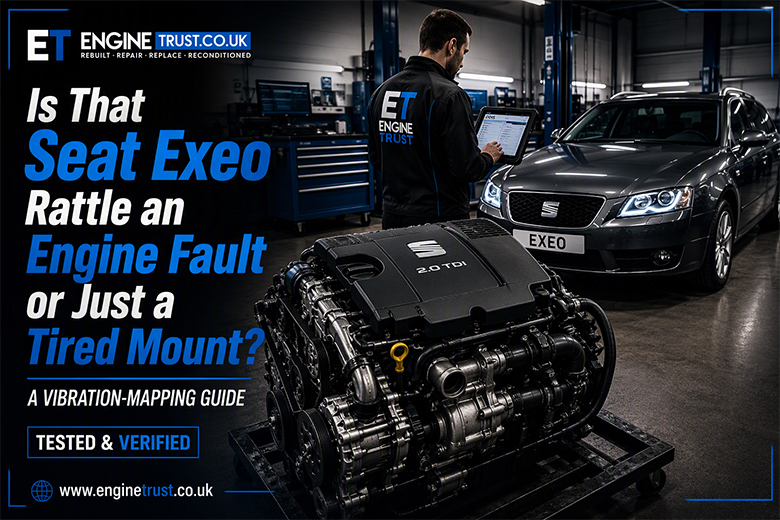
Is That Seat Exeo Rattle an Engine Fault or Just a Tired Mount? A Vibration-Mapping Guide
July 29, 2026
By Engine Trust | Independent Diagnostic Technician | Reviewed by John Miller | Updated 29 July 2026
A Seat Exeo 2.0 TDI engine often transmits vibration through the subframe before the driver ever hears the actual source. The loudest noise in the cabin isn't always the failed part — it can be a tired engine mount, a worn dual-mass flywheel, or a loose exhaust bracket, rather than genuine internal engine wear. This guide sets out how to map vibration properly before accepting an engine-level quote, why the exact engine code matters, and realistic UK replacement costs if it does turn out to be needed.
The Cabin Doesn't Tell You Where the Noise Comes From
A Seat Exeo 2.0 TDI often transmits vibration through the subframe before the driver ever hears the actual source. The loudest noise in the cabin isn't always the failed part — it can be a resonance path travelling through a tired engine mount, a worn dual-mass flywheel, or a loose exhaust bracket.
This matters because a rushed quote based on the loudest symptom, rather than a proper diagnosis of where it's actually coming from, can lead to an unnecessary engine-level repair when the fix was a £150 mount.
It's a genuinely easy mistake to make even for an experienced ear, because vibration through a shared subframe doesn't behave the way sound through open air does — it can feel like it's coming from directly under the driver's seat when the actual source is several components away.
How Proper Vibration Mapping Works
A mapping session uses defined listening points, rpm bands, and load conditions rather than a single test drive. It checks idle smoothness, looks for compression clues, tests mount movement under load, and inspects for exhaust contact with the body — all before a single part is priced.
The same metallic note that sounds like a serious engine fault at idle can, in a genuine number of cases, need nothing more than a mount repair rather than a full engine investigation.
A thorough session typically involves physically pushing or rocking the engine under controlled conditions to see whether the noise changes character, alongside listening with a mechanic's stethoscope at specific points on the block, gearbox bell housing, and exhaust system.
Symptoms Worth Mapping Before You Get a Quote
- Cold-start clatter that fades within thirty seconds
- Cabin boom specifically between 1,600 and 2,000 rpm
- Judder when pulling away in first gear
- Knocking under load on hills
- Exhaust buzz that changes character when the engine rocks under load
If mapping does point to genuine internal wear, that's the point to start looking at engine replacement options — not before.
Why the Engine Code Changes the Conversation
Engine code matters more than the badge on the boot. A 2010 Exeo SE CR TDI fitted with the CAGA code isn't priced or parted the same as every other 2.0 diesel wearing the same badge. Getting the code wrong before ordering parts risks wasted labour and the wrong injectors being fitted.
Public supplier listings show CAGA, CAHA, CJCA and CJCC diesel variants on this platform, with CAGA commonly linked to the 143hp output. Confirm your specific code from the engine bay plate, not from the trim level alone, before requesting quotes.
If Replacement Genuinely Turns Out to Be Needed
| Option | Price Range | Warranty | Best For |
| Used engine | £900–£1,400 | 3 months | Budget repairs on an older example |
| Reconditioned | £1,600–£2,300 | 6–12 months | Balanced cost and reliability |
| Remanufactured | £2,400–£3,200 | 12–24 months | Long-term ownership plans |
| Dealer replacement | £4,500+ | Dealer terms | Rare for this platform given vehicle value |
Mapping Session Checklist
- Confirm the technician tests idle, load and rpm-specific conditions, not just a single idle listen.
- Ask whether engine mounts were physically checked for movement, not just visually inspected.
- Confirm your exact engine code is recorded before any parts are priced.
- Get the mapping findings in writing before agreeing to any follow-up repair.
- Ask what specifically ruled the engine in or out as the source.
Servicing History and Why It Predicts Vibration Faults
Engine mounts and dual-mass flywheels don't fail at random — they wear in proportion to driving style and servicing consistency. A car that's covered most of its miles in stop-start urban traffic, or one that's gone through several owners with gaps in servicing, is a genuinely more likely candidate for mount or DMF wear than a well-serviced motorway-mileage example of the same age.
If you're buying a used Exeo rather than diagnosing one you already own, ask to see service history specifically around clutch and mount work — a car that's already had one flywheel replacement is a reasonable sign the rest of the drivetrain has been looked after, not a red flag in itself.
For owners keeping the car long-term, it's worth having mounts and the flywheel included as a routine check at major services from around 80,000 miles onward, rather than waiting for a noticeable symptom to prompt the conversation.
What to Do If the Noise Comes and Goes
An intermittent fault is genuinely harder to map than a constant one, and it's tempting to dismiss it entirely if it isn't present during a workshop visit. Rather than waiting for it to become constant, keep a short note of exactly when it happens — cold mornings only, after motorway runs, only under acceleration — and share this with your technician before the mapping session starts.
This kind of pattern information often shortens the diagnostic process considerably, since it narrows down which components are even worth testing under which specific conditions, rather than requiring a broad sweep across every possibility.
Frequently Asked Questions
How much does a proper vibration mapping session cost?
Typically £60–£120 depending on the specialist — a small cost against the risk of paying for engine work that was never actually needed.
Can a worn dual-mass flywheel really feel like an engine fault?
Yes — DMF wear commonly presents as vibration and judder that owners assume is internal engine trouble, when the fix is a clutch-and-flywheel job rather than anything involving the block itself.
Is the CAGA engine code hard to confirm myself?
It's stamped on the engine block and listed on the VIN plate — a specialist can confirm it in minutes, and it's worth doing before requesting any quote rather than after parts have already been ordered.
What happens if a supplier quotes based on the wrong engine code?
You risk being sent the wrong injectors or ancillaries, which means wasted labour time and a delayed repair — always have the code confirmed and stated on the written quote before parts are ordered.
If mapping rules out the engine, does that mean the car is definitely fine?
It means the specific noise you raised isn't engine-related — it's still worth addressing whatever mapping did identify (mount, flywheel, exhaust bracket) rather than ignoring it, since these can worsen and create new symptoms over time.
Should I be suspicious of a garage that skips mapping and quotes for engine work immediately?
It's worth asking why. A specialist confident in their diagnosis should be able to explain what specifically pointed to the engine rather than a mount or ancillary — if they can't, a mapping session before committing is the safer route.
Bottom Line
Not every rattle or boom in an Exeo is an engine problem, and a rushed diagnosis based on how loud something sounds in the cabin can lead to unnecessary engine work. Insist on proper vibration mapping first — it's the cheapest, most reliable way to find out what you're actually dealing with.
Book a vibration-mapping session before accepting any engine-level quote based on noise alone.
Editorial note: cost figures reflect UK independent trade ranges observed in 2026 for CAGA/CAHA/CJCA/CJCC engines and will vary by supplier, region and vehicle condition.
Written by John Miller | Dedicated ET Automotive Writer & Mechanic.
Categories
- Uncategorized
- Audi Engines
- BMW Engines
- MINI Engines
- Volkswagen Engines
- Replacement Car Engines in UAE
- Infotainment System
- SUV
- Mercedes Benz Engines
- Citroen Engines
- Engine Care
- petrol engine
- petrol engines
- Citroen C3 Engines
- Ford Engines
- Land Rover Engines
- Jaguar Engines
- Range Rover Engines
- Nissan Engines
- Mazda Engines
- Iveco Engines
- Hyundai Engines
- Range Rover Sport Engines
- Vauxhall Engines
- KIA Engines
- Mercedes Engines
- Toyota Engines
- Hyundai i20 Engines
- Renault Engines
- Infographic
- SEAT Engines
- BMW 5 Series Engines
- Skoda Engines
- Euro NCAP
- Skoda Fabia Engines
- Suzuki Engines
- Fiat Engines
- Mitsubishi Engines
- Volvo Engines