Is a Reconditioned Volvo V40 Engine Reliable?” – After 200 Fits, Here’s My Honest Answer
April 22, 2026
What Exactly Makes a Reconditioned Engine Different from a Standard Used One?
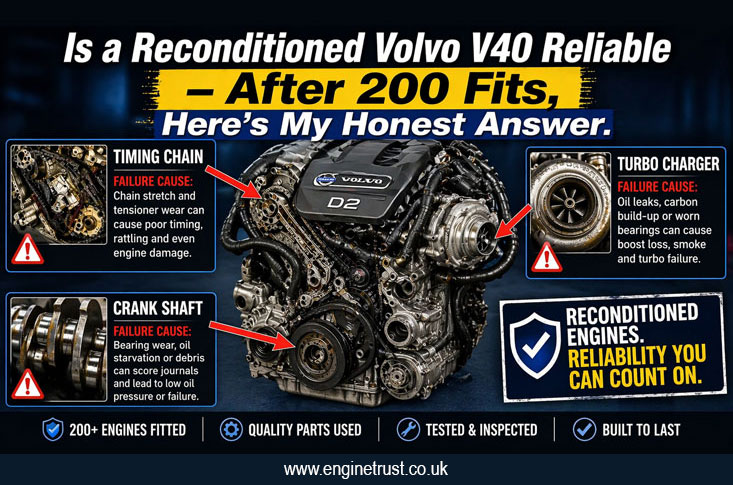
This question comes up almost every time we talk to a customer who's been burned before. When someone asks about a reconditioned Volvo V40, they're often picturing the same thing as a second-hand engine pulled straight from a scrapyard — and that's where the confusion begins. A reconditioned engine is not simply a used unit that's been wiped down and given a clean bill of health. It goes through a structured rebuilding process: the block is stripped back, bores are measured, worn components are replaced to manufacturer tolerances, and the unit is reassembled under controlled conditions. That's a world away from an engine lifted from a donor vehicle with 130,000 miles on the clock and no history of servicing.
The distinction matters enormously in practice. We've seen Volvo V40 D2 units — those 1.6-litre diesels that are particularly sensitive to sludge buildup — come back to us after a customer bought a cheap scrapyard alternative, only for it to fail within four months. A genuinely reconditioned unit will have had compression testing performed, crankshaft grinding carried out where necessary, and cylinder bores honed to the correct clearances. It may also include a reground cylinder head with new valve seats. This is not a cosmetic exercise — it's mechanical restoration to a defined standard. When done properly, it gives the Volvo V40 a powertrain that, in many cases, runs more cleanly than the original engine did in its final miles.
Is a Rebuilt Volvo V40 Engine Actually Worth the Money?
That depends entirely on what you're comparing it to. If you're weighing up a rebuilt Volvo V40 engine against a brand-new replacement from a main dealer, the cost difference is significant — and in most cases, an owner of a car that's worth £3,000–£5,000 simply cannot justify spending £4,000–£6,000 on a factory-fresh unit. The reconditioned route typically lands somewhere between £900 and £2,200 depending on the engine variant (the 2.0 T5 petrol and the D4 diesel units sit at opposite ends of that range), which represents a sensible investment when the bodywork and ancillaries on the car are still sound. You are essentially paying for the mechanical core of the car to be renewed, while keeping the rest of the vehicle you already know.
What genuinely affects value for money is the warranty and the work that's included. A supplier offering a remanufactured Volvo V40 engine should be able to tell you exactly what machining work was carried out, what OEM parts were used, and what the warranty covers. We've had customers come to us after purchasing an engine online, only to discover the warranty excluded any consequential damage — meaning if a new water pump failed and caused overheating, the supplier wouldn't cover it. Always ask for a breakdown of what's included in the price: does it cover ancillary parts like the timing chain or belt, the thermostat, and the oil seals? A transparent supplier will answer those questions without hesitation. One who deflects is worth walking away from.
How Do You Find a Trustworthy Supplier When Searching for a Replacement Engine?
Last winter, a small independent garage in Nottingham ordered a replacement Volvo V40 engine from a supplier they found on the second page of a search result. The listing was vague, the price was unusually low, and there was no mention of what testing had been carried out. When the engine arrived, the head gasket showed signs of previous failure and the seller claimed it was within acceptable condition. The garage lost three weeks of labour time and a client who never came back. The lesson isn't that reconditioned engines are unreliable — it's that provenance matters more than price.
When you're searching for Volvo V40 engine supplied and fitted, or comparing options on where to find engine for my car, look beyond the headline price. Does the supplier have verifiable customer reviews on Trustpilot or Google? Can they provide documentation of the reconditioning process, including the mileage of the donor vehicle and any HPI clearance check results? Is there a surcharge or core return policy that requires you to send back your old unit, and is that policy written clearly in their terms? The best suppliers in the UK market are upfront about all of this. They'll also offer a buyer protection guarantee, not just a generic 30-day return window. Verified mileage documentation and clear service history records on the donor unit are two of the strongest indicators of a credible operation.
What's the Real Difference Between Engine Supply Only and Engine Supply and Fit?
This is one of the most consequential decisions a Volvo V40 owner makes, and it's often made without enough thought. Engine supply and fitting as a combined service costs more upfront — typically £300–£700 in additional labour depending on the engine type and the garage's hourly rate — but it eliminates a number of risks that tend to bite people who try to split the arrangement. When a garage fits an engine, they've sourced themselves, they take on responsibility for the completed job. If there's a post-installation fault, there's a single point of accountability. When you supply the engine and use a separate mechanic, accountability splits — the mechanic says it's the engine, the engine supplier says it's the installation.
For anyone who wants Used engine supply and fits near me handled as a single transaction, it's worth knowing what a proper professional fitting involves. The engine hoist, specialised torque wrenches, a full fluid flush and refill of both coolant and oil, and a post-installation diagnostic scan for DTCs (diagnostic trouble codes) are all part of a correctly executed job. ECU reprogramming is sometimes required on later V40 models with the Drive-E engine range, particularly when moving between engine variants. Ancillary parts — the water pump, timing components, and accessory belt — should be replaced during the fit regardless of apparent condition, because failing to do so is the most common reason a newly fitted engine fails within six months. If a fitting quote doesn't include any of these items, ask specifically why.
What Are the Hidden Costs Nobody Talks About When Buying a Reconditioned Engine?
The headline reconditioned engine price is rarely the final figure. This is true across the board, but it's particularly relevant for the Volvo V40, which uses a range of engines — from the D2 1.6 diesel to the T5 2.0 petrol and the later D4 and T3 Drive-E units — each with different ancillary complexity. The VAT position is often misunderstood: many online listings show prices ex-VAT, which means the figure climbs by 20% before you've even thought about labour. Add in the surcharge exchange policy, which typically requires you to return a clean, intact old core unit or pay an additional deposit of £100–£300, and the total cost of ownership looks quite different from the initial quote.
Labour rates in the UK currently range from around £50 per hour at smaller independents to £120–£150 at specialist garages in urban areas, and a Volvo V40 engine replacement realistically takes six to ten hours depending on the variant. That puts labour alone at £300–£1,500 on top of the engine cost. Some suppliers offer fixed-price quotes that bundle the engine, fitting, and ancillary parts into one figure — this is generally the safest route, as it removes the risk of post-installation surprises. One additional cost that's frequently missed is recovery service coverage during the warranty period: if the reconditioned engine fails on the road and you haven't confirmed that the warranty includes recovery, you'll face that bill alone. Read the warranty claim procedure carefully — a supplier who makes the process complicated is signalling something important about how they'll behave when something goes wrong.
Where Should You Actually Buy a Reconditioned Engine in the UK, and What Should You Ask?
There is no universal answer to where to buy engines in the UK, because the right supplier depends on your engine variant, your budget, whether you want supply-only or a full fit, and how much risk you're willing to accept. What we can say, after fitting well over 200 engines into Volvo V40s of various generations, is that the single strongest predictor of a good outcome is documentation. A supplier who can show you exactly what machining was done — crankshaft grinding, block honing, oversized pistons and rings where necessary, cylinder head resurfacing — and who can provide British Engineering Standards compliance paperwork, is a supplier worth taking seriously. Reconditioned engines UK suppliers who rely entirely on vague language like "fully tested" without specifying how they were tested are far riskier, regardless of price.
When you're narrowing your search and comparing reconditioned engines price list options from multiple suppliers, ask these questions directly: What is the mileage of the donor vehicle? Is the warranty parts-only, or does it include labour? What's the procedure if the engine develops a fault within the warranty period — do I need VOSA-approved garage documentation? Is the price VAT inclusive? And critically — have reconditioned engines fitted near me using this specific unit, or are you shipping something that's never been road-verified in a Volvo V40? The best suppliers will answer every one of these questions without fuss, because they have nothing to hide. For a second hand Volvo V40 that still has good bodywork and a decent interior, a quality recon engine is not a compromise — it's the smartest mechanical investment you can make.
Written by John Miller | Dedicated ET Automotive Writer & Mechanic.
Categories
- Uncategorized
- Audi Engines
- BMW Engines
- MINI Engines
- Volkswagen Engines
- Replacement Car Engines in UAE
- Infotainment System
- SUV
- Mercedes Benz Engines
- Citroen Engines
- Engine Care
- petrol engine
- petrol engines
- Citroen C3 Engines
- Ford Engines
- Land Rover Engines
- Jaguar Engines
- Range Rover Engines
- Nissan Engines
- Mazda Engines
- Iveco Engines
- Hyundai Engines
- Range Rover Sport Engines
- Vauxhall Engines
- KIA Engines
- Mercedes Engines
- Toyota Engines
- Hyundai i20 Engines
- Renault Engines
- Infographic
- SEAT Engines
- BMW 5 Series Engines
- Skoda Engines
- Euro NCAP
- Skoda Fabia Engines
- Suzuki Engines
- Fiat Engines
- Mitsubishi Engines
- Volvo Engines