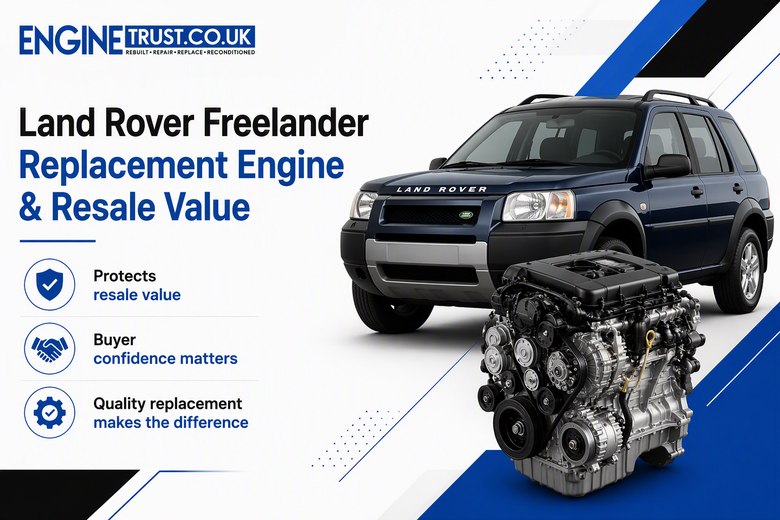
Does a Replacement Engine Protect or Hurt Your Land Rover Freelander's Resale Value?
July 27, 2026
Website: Engine Trust | Author: John Miller | Date: 27 July 2026
A buyer who hears "new engine" on a Land Rover Freelander doesn't automatically relax — they ask what type of replacement, who fitted it, whether the original fault was properly diagnosed, and whether the paperwork actually stacks up. This guide covers how to protect resale value through an engine replacement, which faults scare buyers most by engine type, and what fair UK replacement costs look like across the K-Series, TD4 and 224DT range.
Buyers Ask More Than "Does It Run?"
A buyer who hears "new engine" doesn't automatically relax. They ask what type of replacement, who fitted it, whether the original fault was properly diagnosed, and whether the paperwork actually stacks up. A Freelander with a clean, documented engine replacement can present better in an advert than one carrying an unresolved smoke, rattle, or coolant-loss history — but only if the work is genuinely well documented.
An engine label alone doesn't prove compatibility. Freelander 1 petrol K-Series units, TD4 diesels, and Freelander 2's 224DT engine each need different checks around mounts, ancillaries, ECU matching, and cooling history — getting this wrong is a common source of buyer distrust even when the mechanical work itself was sound.
An informed buyer researching this model online will already know these engines have well-documented weak points. Rather than treating that as a threat, use it to your advantage: a seller who can speak confidently and specifically about what failed and what was done about it comes across as far more trustworthy than one who says only “it's had a new engine.”
Why the Familiar Dealer Logo Isn't the Whole Answer
Dealer pricing feels comforting because the badge is familiar, but the resale question isn't only "who supplied it?" — it's whether the replacement actually suits the car's age, mileage, and realistic market ceiling. Overspending can be just as damaging to your finances as under-repairing.
If a 2008 Freelander 2 TD4 is realistically worth £3,800 privately, a £5,000 dealer engine won't turn it into a £6,000 car. The sensible route is comparing quotes from an independent specialist who shows supply, fitting, warranty, and core terms clearly, rather than assuming the most expensive option automatically protects the most value.
Which Faults Scare Buyers Most, by Engine
- 1.8 K-Series petrol: coolant loss, head gasket history and overheating are the classic concerns buyers ask about directly.
- 2.0 TD4 diesel: injector issues, neglected crankcase breathers, and turbo wear.
- 2.2 TD4/SD4 diesel: DPF, EGR, turbo actuator and timing-related noises.
- 3.2 petrol: higher running costs and scarcer parts availability narrow buyer demand regardless of engine condition.
Buyer fear starts well before total failure — a cold-start rattle, mayonnaise-like residue under the oil cap, blue smoke, or a restricted-performance warning makes the car feel risky even if it's still perfectly driveable, and that perception shows up directly in what buyers are willing to offer.
Building a Documentation File That Actually Reassures Buyers
A folder of invoices means little on its own if it doesn't tell a coherent story. Aim to include: the original fault diagnosis (what failed and why), the replacement engine's code and mileage, confirmation of which ancillaries were renewed at the same time, and the warranty certificate with its terms clearly stated.
This kind of file does two things at once — it protects you if a buyer's independent inspection raises a question, and it lets you set a fair asking price with confidence rather than guessing at what the market will accept.
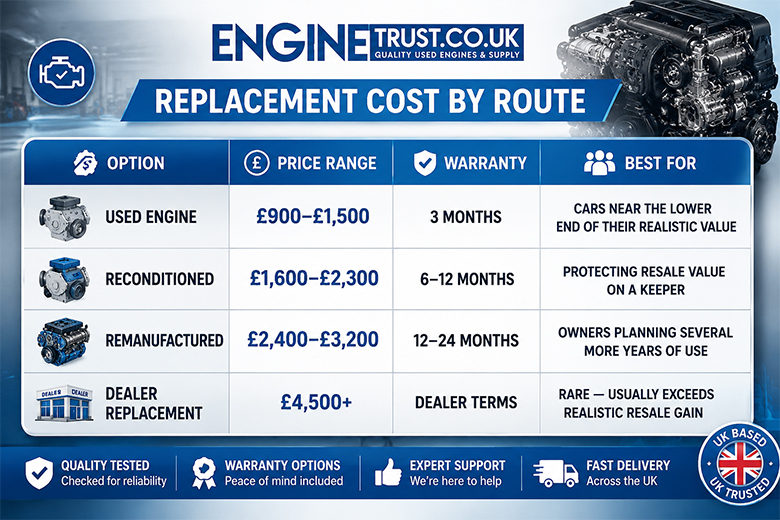
Replacement Cost by Route
| Option | Price Range | Warranty | Best For |
| Used engine | £900–£1,500 | 3 months | Cars near the lower end of their realistic value |
| Reconditioned | £1,600–£2,300 | 6–12 months | Protecting resale value on a keeper |
| Remanufactured | £2,400–£3,200 | 12–24 months | Owners planning several more years of use |
| Dealer replacement | £4,500+ | Dealer terms | Rare — usually exceeds realistic resale gain |
Before You List the Car
- Get a quick private valuation check to confirm your realistic market ceiling.
- Compile the engine invoice, warranty certificate and original fault diagnosis into one file.
- Photograph the replacement engine's code and any new ancillaries fitted.
- Be ready to explain, specifically, what failed on the original engine and why.
- Price the car against comparable listings with a documented engine history, not against ones with no history at all.
How Buyers Actually Use This Information
Most private buyers researching a Freelander purchase will already have read about the K-Series head gasket issue or TD4 injector concerns before they ever view the car — this model's reputation is well known. That means a seller who volunteers the details upfront, rather than waiting to be asked, tends to be trusted more, not less.
It's also worth anticipating that a cautious buyer may bring their own independent inspector. Having your documentation file ready to hand over at that point — rather than promising to "find the paperwork later" — meaningfully speeds up the sale and reduces the chance of last-minute price renegotiation based on uncertainty alone.
A Note on Parts Availability by Model Year
Freelander 1 K-Series parts are, in general, straightforward and inexpensive to source given how long the platform has been on UK roads. Freelander 2's TD4 and SD4 ranges sit in a slightly different position — mainstream service parts remain easy to find, but some specific electronic and turbo components can take longer to source than owners expect, which is worth factoring into any downtime estimate a specialist gives you.
Frequently Asked Questions
Will a replacement engine ever add more value than it costs?
Rarely in pure resale terms — the value is more in avoiding a steep discount for an unresolved fault than in a premium for a new unit. Match the spend to the car's realistic ceiling rather than expecting the repair to pay for itself.
What documentation should I keep to protect resale value?
The invoice showing engine code and mileage, the warranty certificate, and ideally photos or notes from the original diagnosis explaining what failed and why. Buyers and independent inspectors will want to see this, not just hear about it.
Is a K-Series head gasket failure a dealbreaker for buyers?
Not if it's properly repaired and documented — this is a widely known issue on this engine, and informed buyers are often reassured by evidence it was fixed correctly rather than alarmed by the history.
Should I match the replacement engine exactly to the original spec?
Yes, wherever possible — mismatched mounts, ancillaries or ECU expectations create exactly the kind of buyer-facing questions that erode trust and value, even if the car runs fine day to day.
Is it worth getting an independent valuation before deciding how much to spend on the engine?
Yes — a quick private valuation check before committing to a repair route stops you overspending relative to what the car can realistically achieve on resale, which is the single most common financial mistake owners make on this model.
How much detail should I give a prospective buyer about the original fault?
More than most sellers instinctively offer. Being specific — "the head gasket failed following a coolant leak, replaced with a reconditioned engine and new water pump" — reads as far more credible than a vague "new engine fitted," and it tends to reduce haggling rather than invite it.
Bottom Line
On a Freelander, the engine repair route matters less for prestige and more for honest documentation. Match the spend to the car's realistic value, keep the paperwork thorough, and a well-documented replacement can protect resale value rather than becoming another unexplained line in the car's history.
Get an independent valuation alongside your repair quote, and keep full documentation of the engine code, mileage and diagnosis for future buyers.
Editorial note: cost figures reflect UK independent trade ranges observed in 2026 for K-Series, TD4 and 224DT engines and will vary by supplier, region and vehicle condition.
Written by John Miller | Dedicated ET Automotive Writer & Mechanic.
Categories
- Uncategorized
- Audi Engines
- BMW Engines
- MINI Engines
- Volkswagen Engines
- Replacement Car Engines in UAE
- Infotainment System
- SUV
- Mercedes Benz Engines
- Citroen Engines
- Engine Care
- petrol engine
- petrol engines
- Citroen C3 Engines
- Ford Engines
- Land Rover Engines
- Jaguar Engines
- Range Rover Engines
- Nissan Engines
- Mazda Engines
- Iveco Engines
- Hyundai Engines
- Range Rover Sport Engines
- Vauxhall Engines
- KIA Engines
- Mercedes Engines
- Toyota Engines
- Hyundai i20 Engines
- Renault Engines
- Infographic
- SEAT Engines
- BMW 5 Series Engines
- Skoda Engines
- Euro NCAP
- Skoda Fabia Engines
- Suzuki Engines
- Fiat Engines
- Mitsubishi Engines
- Volvo Engines